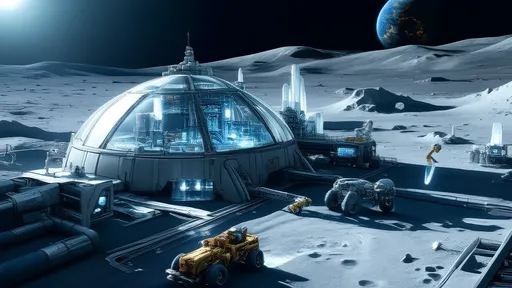
The concept of establishing a lunar ice mining and smelting facility has transitioned from science fiction to a tangible goal within the next decade. Among the most critical challenges is the industrial-scale production of oxygen through in-situ water electrolysis. This process, while theoretically straightforward, presents a labyrinth of technical, logistical, and environmental hurdles when attempted on the Moon. Unlike Earth, where industrial infrastructure is abundant, lunar operations must contend with extreme temperatures, abrasive regolith, and the absence of a breathable atmosphere. The success of such a venture hinges on solving these problems without relying on terrestrial resupply missions.
The Promise of Lunar Ice Deposits
Recent orbital surveys have confirmed the presence of water ice in permanently shadowed craters at the Moon’s poles. These deposits, potentially millions of tons in volume, are the cornerstone of future lunar industrialization. Water is not just a source of drinking and irrigation—it is the feedstock for oxygen production, a vital resource for life support and rocket propellant. Electrolysis, the process of splitting water into hydrogen and oxygen using electricity, is the most promising method for extracting these elements. However, scaling this process to meet industrial demands on the Moon is far from trivial.
Extreme Environmental Constraints
The Moon’s environment is unforgiving. Temperatures in shadowed craters hover around -250°F (-157°C), turning water ice into a substance as hard as granite. Mining equipment must operate in perpetual darkness, with only artificial lighting, while enduring constant bombardment from micrometeorites. Even after extraction, the ice must be processed in thermally controlled chambers to prevent sublimation. Electrolysis units, typically designed for Earth’s stable conditions, must be re-engineered to function in near-vacuum and extreme thermal cycles. A single malfunction could halt production for months, given the difficulty of repairs in such a hostile setting.
Energy: The Make-or-Break Factor
Producing oxygen at an industrial scale requires vast amounts of energy. Solar power, the most obvious solution, is unreliable in polar regions where sunlight is scarce. Nuclear reactors, while capable of providing steady output, introduce their own complexities—radiation shielding, heat dissipation, and regulatory concerns. Moreover, electrolysis efficiency drops in low-pressure environments, meaning more energy is needed to achieve the same output. Without a robust and uninterrupted power supply, the entire operation risks becoming economically unviable.
The Dust Problem: A Silent Saboteur
Lunar regolith is not just dirt—it’s a fine, electrostatic powder that clings to everything. Unlike Earth’s weathered soil, Moon dust is sharp and abrasive, capable of wearing down machinery seals, clogging filters, and short-circuiting electronics. In an oxygen production facility, dust infiltration could corrode electrolysis cells or contaminate the water supply. Mitigation strategies, such as magnetic filtration or electrostatic barriers, remain untested at the scales required for continuous industrial operation.
Scaling Up: From Lab to Factory
Small-scale electrolysis experiments on Earth have proven the basic feasibility of extracting oxygen from lunar ice simulants. However, industrial production demands orders of magnitude greater throughput. A single Starship-class lunar lander might require 1,000 tons of oxygen for a return trip to Earth—equivalent to processing thousands of tons of water ice. Factories must be largely autonomous, with minimal human oversight, and capable of self-repair. Current prototypes are nowhere near this level of reliability or output, raising questions about the timeline for achieving practical scalability.
Economic Viability: Who Bears the Cost?
Even if the technical challenges are overcome, the economics of lunar oxygen production remain murky. Initial capital expenditures will be astronomical, with no guarantee of short-term returns. Governments may fund early-stage development, but sustained operations will likely require public-private partnerships. The price of lunar oxygen must compete with the cost of shipping it from Earth—a figure that will decrease as reusable rocket technology advances. Without a clear path to profitability, investment in large-scale facilities may stall.
The Road Ahead: Incremental Progress or Bold Leap?
Pioneering lunar industry will demand a blend of incremental innovation and bold engineering gambles. Some advocate for starting small—deploying pilot plants that produce just enough oxygen for a lunar base, then gradually scaling up. Others argue that only a massive, Apollo-style commitment can overcome the inherent challenges. What’s certain is that the first successful lunar smelting facility will rewrite the rules of space exploration, turning the Moon from a destination into a hub for deeper ventures into the solar system.

By /Jul 28, 2025
By /Jul 28, 2025

By /Jul 28, 2025

By /Jul 28, 2025

By /Jul 28, 2025

By /Jul 28, 2025
By /Jul 28, 2025
By /Jul 18, 2025

By /Jul 28, 2025
By /Jul 28, 2025
By /Jul 28, 2025

By /Jul 28, 2025

By /Jul 28, 2025

By /Jul 28, 2025
By /Jul 28, 2025

By /Jul 28, 2025
By /Jul 28, 2025

By /Jul 28, 2025
By /Jul 28, 2025
By /Jul 28, 2025